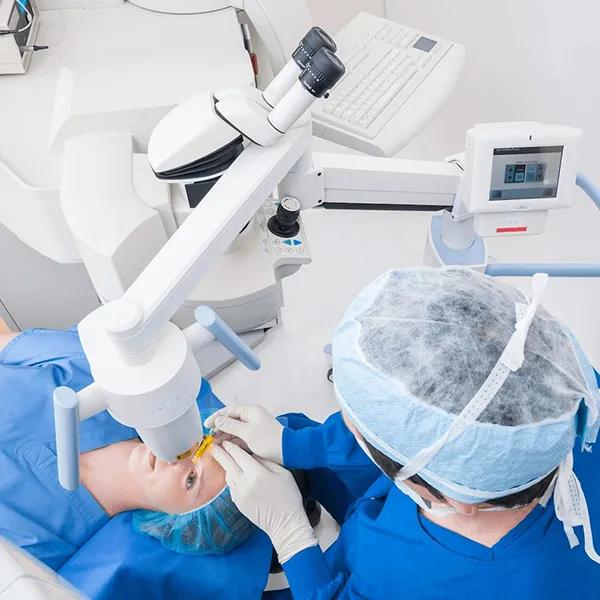
Corneal Cross-Linking Surgery in Chandigarh
Are you trying to get rid of cornea issues? Consider Corneal Cross Linking surgery in Chandigarh at Drishti Eye Hospital with expert care. Schedule your consultation to explore if corneal cross-linking could be the solution to improve weakened cornes.
Call to ask any question +91-708-7219008
Dr. Ashok Gupta
(Chairman and founder)Corneal Cross-Linking (CXL)
CXL is a surgical procedure designed to address a weakened or misshapen cornea. Diseases or certain surgeries may compromise collagen, a crucial element in maintaining corneal integrity. Additionally, by creating “cross-links” between new collagen fibers, CXL strengthens and fortifies the cornea.
Types of Corneal Cross-Linking
Two primary types exist epi-off and the experimental epi-on. (“Epi” stands for epithelium, the outer corneal layer.)
Epi-off entails removing the epithelium before administering drops.
Epi-on involves loosening the epithelium with drops or a sponge before drop application.
Corneal Cross-Linking (CXL) Surgery
CXL is typically an outpatient procedure. Here’s what to expect:
Numbing eye drops are administered while lying down.
The ophthalmologist removes the outer corneal layer (epithelium), allowing deeper penetration of medication. Pain is usually absent due to the numbing drops.
Riboflavin eye drops are applied to the cornea for around 30 minutes.
Subsequently, a specialized device emits focused UV light onto the cornea for nearly 30 minutes, activating the riboflavin and facilitating collagen fiber bonding.
A bandage contact lens is placed over the eye to aid healing, usually for about a week.
Antibiotic and steroid drops may be prescribed to facilitate healing.
The Side Effects Corneal Cross-Linking
Common side effects may include sensations of foreign bodies in the eye, light sensitivity, dry eyes, blurry vision, or mild eye discomfort. Rarely, more serious complications such as worsening keratoconus, scarring, infection, or vision loss may occur.
Recovery Timeline
Vision typically improves within 2 to 3 weeks, but full stabilization may take several months. Consult your physician regarding resuming regular activities, usually within 1 to 2 weeks post-surgery. Additionally, vision stability may take months, necessitating eyeglasses or contact lens adjustments

Who Would Benefit from Corneal Cross-Linking (CXL)?
CXL is recommended for individuals with
Keratoconus: A condition where the cornea progressively thins and assumes a cone-like shape, leading to blurry vision and related symptoms.
Corneal bulging (ectasia) following LASIK surgery: In rare instances, corneal tissue removal during LASIK weakens the cornea, causing it to protrude, akin to keratoconus.
FAQs
CXL is recommended for patients whose corneal scans indicate worsening keratoconus or those at high risk of progression. Typically, keratoconus stabilizes by the mid-30s due to natural cross-linking, making CXL unnecessary for older patients.
The actual procedure lasts about an hour, but plan to spend approximately two hours at the office to allow for preparation and recovery before returning home.
Vision assessment is typically conducted a week post-surgery to evaluate driving safety. Contact lens wear can resume once the eye surface heals, usually by the second week.
If both eyes require CXL, simultaneous treatment is an option. Alternatively, if you prefer to stagger the treatment, please communicate this preference during the clinic appointment preceding your procedure.
While some patients may experience minimal discomfort during the standard epi-off crosslinking (CXL) procedure, others may feel discomfort for a few days afterward. Symptoms like burning, gritty sensation, light sensitivity, or glare are common. Your doctor will provide numbing drops during the procedure and offer post-operative instructions for pain management, which may include over-the-counter or prescribed medications.
Follow the prescribed regimen for eye drops diligently. Maintain normal hygiene habits but take care to avoid water contact with your eyes. Exercise is permitted but refrain from swimming until your eye surface has fully healed. Vision will be assessed a week after the procedure to determine driving suitability. Contact lens wear can usually resume once the eye surface has healed, typically within two weeks post-procedure.
Most likely, yes. Crosslinking doesn't eliminate the need for corrective eyewear. If you relied on glasses or contacts before the procedure, you'll likely still need them afterward. However, the frequency of prescription changes may decrease, and the comfort and fit of contact lenses may improve.
Yes, typically you will remain awake during the treatment. You may receive medication to induce relaxation along with numbing anesthetic drops.
Yes, as per the FDA-approved protocol, the removal of the epithelium is required for the procedure. Your doctor will administer topical anesthesia to numb the eye before proceeding with epithelium removal. This step is crucial in preparing the eye for effective penetration of the corneal tissue by the medication used in the cross-linking process.
Although generally safe, CXL carries risks such as vision loss (approximately 3% of cases), which may result from haze, scarring, corneal irregularities, or infection. Most cases of visual loss can potentially be reversed with a corneal transplant. Without CXL, about 20% of keratoconus patients will eventually require a transplant, with potentially higher risks for those with documented disease progression.
Following post-CXL instructions diligently enhances healing and minimizes risks, paving the way for clearer vision and improved eye health.
No, keratoconus currently has no cure, but it can often be effectively managed. Crosslinking may stabilize keratoconus, potentially reducing vision changes and other associated symptoms. Regular visits to your doctor for monitoring and maintenance of ocular health, as well as the use of glasses or contact lenses, are still necessary.
Yes, it's common for your vision to fluctuate following crosslinking (CXL) as your eyes react to the treatment. You may experience worsened vision, glare, halos, or light sensitivity during the early stages of healing. These symptoms typically resolve within a few days to a month. In the first few months post-CXL, vision may decrease further as new crosslinks form and collagen remodels, but eventually, stability or improvement may occur. However, the primary goal of CXL is to halt or slow down the progression of keratoconus rather than to improve vision.
While severe cases of keratoconus may sometimes require corneal transplants, advances in crosslinking and contact lens technology have reduced the necessity for such drastic measures. While corneal transplants still occur, they're less common than before due to the effectiveness of treatments like crosslinking.
Testimonials
Some reviews from our clients
EXCELLENT Based on 5711 reviews Posted on Shweta GuptaTrustindex verifies that the original source of the review is Google. It was my mom cataract surgery...it went very smooth... The staff was very cooperative....Posted on HEMRAJ RAJPUTTrustindex verifies that the original source of the review is Google. ExilentPosted on Multan SinghTrustindex verifies that the original source of the review is Google. Expireced staff Neat and clean campus Doctors behavoiur was very politePosted on Banti BhiwaniTrustindex verifies that the original source of the review is Google. GoodPosted on rishi rangaTrustindex verifies that the original source of the review is Google. Very nice & cooperative staff, outstanding hospitality.Posted on Jyotsna kumarTrustindex verifies that the original source of the review is Google. Excellent servicePosted on Vyom SharmaTrustindex verifies that the original source of the review is Google. Well qualified Doctors & cooperative staff..Highly recommended for eye care..Posted on Ranbeer ThakurTrustindex verifies that the original source of the review is Google. Wonderful drishti eye hospital and thanks for dr. Ashok gupta sir very nice all staff